In the editor’s introduction to Burke + The Posthuman, Mays, Rivers, and Sharp-Hoskins ruminate on the possibility of placing Kenneth Burke’s work in the context of posthumanism. The primary obstacle to a project like this is Burke’s insistence that humans are exceptional, that “we are something special” (from “Revival of the Fittest,” quoted in Mays, Rivers, & Sharp-Hoskins 2, emphasis added). By “special” he usually meant especially bad, but special nonetheless. Mays, Rivers, and Sharp-Hoskins conclude that Burke is “compatible with posthumanism. Not prescient. Not anticipatory. Not Nascent” (3-4). They frame the articles in the collection as transdisciplinary “interanimations” of Burke and Posthumanism, rather than discussions of Burke as anything close to a posthumanist.
This talk generally follows that lead, presenting some ideas from Burke’s article, “Semantic and Poetic Meaning,” that seem closely intertwined with strategies for presenting posthuman scholarship, without ignoring Burke’s humanist convictions. In particular, I’d like to consider the 2017 “Rhetorical Bestiary” compiled as a special issue of Rhetoric Society Quarterly as a case study for the use of poetic language as a rhetorical device for exploring more-than-human rhetorics.
In introducing the bestiary and its entries, Gordon, Lind, and Kutnicki provide the following guidance for how each entry should be read, which I will quote at length. As I read, I will highlight some of the phrases they use to describe the bestiary’s unconventional approach to scholarly prose :
Looser modes of engagement to be found in the writing of bestiary entries also stress porous and permeable multi-species boundaries, and animate a continuum of animal rhetoric—and rhetorical theory. If we are to get even a whiff of what animal rhetoric might teach us, vibrant, even excessive playfulness and lived expressions are necessary, particularly those that expand menageries and promote an open-ended range of rhetoric (Massumi). Such attempts to re-territorialize rhetoric according to ecological habitats risk looking and feeling “out of place,” like an invasive species of argument that marks things and then scurries away before they are caught. As such, we request the reader’s patience and openness to the rhetorical bestiary’s presentation of an intellectual style that, at times, may look and feel a-stray . . . encounters with animals are often wily and elusive—and . . . we need theoretical prose to match. The bestiary might be read, then, as coyote-like itself, an animate form that welcomes reflection on academic discourse and excites disruptions in traditional scholarly prose. (226-27)
In this passage, we see not only a response to potential naysayers, but also an assertion that unconventional language is necessary in disrupting an anthropocentric view of rhetoric. While Burke’s own view of rhetoric was decidedly anthropocentric, he was also interested in disruption and change and the strategies for enacting that change through language.
In “Semantic and Poetic Meaning,” Burke takes up a “rhetorical defense of rhetoric,” arguing that [quote] “the ideal of a purely ‘neutral’ [scientific] vocabulary, free of emotional weightings, attempts to make a totality out of a fragment” (138). In the process of defending this thesis, Burke theorizes on the nature of language, differentiating between “poetic” and “semantic” ideals. He describes the “semantic ideal” as a concept of communication which seeks the “elimination of a [morally/aesthetically] weighted vocabulary from the start” (149), with “the aim to evolve a vocabulary that gives the name and address of every event in the universe” (141). This is the ideal for language typically followed by academic prose. When we ask for precise, clear, unbiased language, we’re pursuing that semantic ideal by removing ambiguity and giving things a “name and an address” in the theoretical landscape.
The “poetic ideal,” on the other hand seeks “exposure to the maximum profusion of [moral-aesthetic] weightings” (149); instead of attempting to remove the “attitudinal ingredient” from language, it foregrounds the attitudes and experience of the speaker.
Before I move further with this, it might help to have a passage to work with. Here are the opening two sentences of Plec, Hughes, and Stalley’s bestiary entry, “The Salmon Imperative” :
She is a sojourning critic of the dam, the logging operation, the power plant, the cattle ranch, the pesticide-swathed field, writing into the redd her symbolic legacy and memory of this place. Her eggs become fry, become parr, then smolt (those who survive their streamborn infancy). They will drift and swim, growing and confronting the challenges of aquatic life—habitat destruction, warming rivers and oceans, commercial fishing, disease, predation, angling, and all the other obstructions of an upstream struggle. (Plec, et al. 247)
This decidedly epideictic introduction stands apart from typical academic prose in a couple of ways. First, it uses evocative language that engages emotion, sensation, and perception simultaneously. The salmon as a “sojourning critic of the dam” could be, and is meant to be, interpreted in multiple ways. Second, this passage is openly pro-salmon. Taken as a whole, there is an attitude of praise, respect, or even reverence toward the salmon in the language used here.
Burke would not be surprised, because for him, this is what poetic language is good for.
For Burke, the poetic ideal seeks to [quote] “derive its vision from the maximum heaping up of all these emotional factors, playing them off against one another, inviting them to reinforce and contradict one another, and seeking to make this active participation itself a major ingredient of the vision” (148). In other words, poetic language works not by trying to mean only one thing (think scholarly prose), but by bringing as much meaning as possible to bear, and by so doing laying bare the judgements and motivations of the writer.
This is the kind of language, Burke argues, that is actually effective at communicating across perspectives. A specialized or as Burke would call it “sanitized” scientific or scholarly vocabulary works well within the established perspective of a discipline, but to someone outside that perspective the same words lose their power to communicate. Poetic language, because it carries as much emotional, sensational, and moral weight as possible, invites a multitude of channels for communication, often at the most primal levels of lived experience.
When Diane Keeling describes in her bestiary entry the zoomorphic [quote] “possibilities for interaction through metaphor—the recognition that human eyes, noses, ears, and mouths are similar to, although different from, wolves,” she is speaking to the sensory experience humans share, at least in part, with other animals (235). This shared experience forms a kind of “common sense” that opens doors for possible posthuman rhetorics (236). Poetic language, with its heaps of meaning, taps into this “common sense” and many other means of persuasion that are not strictly human, providing a vocabulary that can hopefully dissolve some of the boundaries set up by our disciplinary language about rhetoric.
Perhaps the most striking example of poetic language in the bestiary is Kristin Pomykala’s conclusion to her entry on serpentine rhetoric:
In a move more rhetorically powerful than any ethical injunction halting human violence on nature, a sensuous moment of intertwining with the serpent can enact onto-epistemological shifts and dispositional transformations. Opportunities remain to re-member imaginatively, transversally, the feeling of raising serpentine energy along one’s spine, sloughing off old skin, and slithering away in a sidewinding horizontal direction or down into the depths of uncertainty. With snakeskins and seeds, we open up a space for the otherwise. Through a serpentine mêtis and mythopoetics of cunning wisdom and knowledge production, we respond to the hum of rhetorical energy coursing through our more-than-human relations. In this intertwining we may still live to tell new stories with the snakes and the rest of our strange kin. (272)
Here Pomykala deliberately engages the analytical, sensory, emotional, and moral accoutrements of language to imagine a posthuman rhetoric that is very different from one centered on human reasoning and sociality. It’s a passage meant to be experienced as much as understood, and it invites the reader to participate in its interpretation.
Burke’s final point about the poetic ideal is that, given time, the heaping up of poetic meaning can produce an [quote] “image for action” (147, emphasis in original), meaning the correct action to take may become clear, even without articulable logical support. By experiencing the layering (Burke calls it a going “through the battle” [149]) of many far-reaching, intertwined, judgemental, and often conflicting utterances in a poetic paradigm, a sense of the totality emerges, invoking a response. A hope for this kind of response shows up in Debra Hahee’s concluding remark on the Bestiary:
Across these two bestiaries runs an enduring lesson: description matters because aesthetics matter. Description and depictions shape what others see, whether they might step closer or recoil; in the case of featured species, whether viewers, readers, or bestiary keepers might work to save or abandon them. Description and aesthetics matter politically because they direct attention and create focus—in short because of how they work rhetorically. Such is the promise the bestiary form holds for the future. (290)
Although Burke never had such a vision in mind, I offer his framework of semantic and poetic ideals as a possible way to talk about our talking about posthuman rhetorical imaginings.
 I was recently introduced to a book called Rhetoric and The Arts of Design by Davis Kaufer and Brian Butler. Michael Salvo had us read it as part of a graduate course on professional writing theory. The project of their book is to offer a “theory of rhetoric as design,” and they argue that “theories of written argument, formed for purposes of description or instruction, must be based on sound general theories of rhetoric, and that sound general theories of rhetoric are, at their base, theories of design” (xvi-xvii). They spend the majority of the book outlining a theory of rhetoric in which all rhetorical action can be broken down into plans, tactics, and events. They argue that a rhetorician “designs” when he/she selects, modifies, and assembles a combination of these three elements into an act of communication.
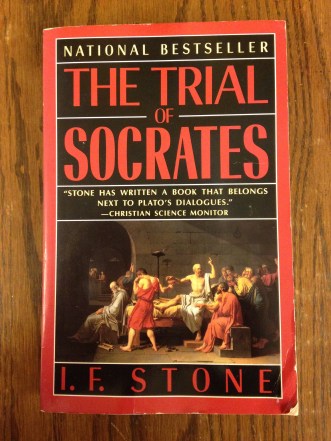 As part of pre-reading for this semester’s course on Classical Rhetoric, I read through the first part of I.F. Stone’s The Trial of Socrates. Having taken more classes on the history of rhetoric in my graduate studies than on any other subject, I approached the book with what I felt like was a heavy dose of skepticism. With that preface, I’ll admit I find Stone’s view of the situation very convincing.
 pilcrowed