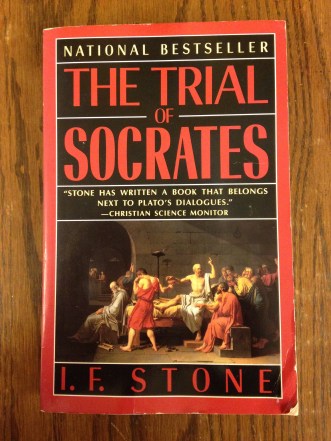
 As part of pre-reading for this semester’s course on Classical Rhetoric, I read through the first part of I.F. Stone’s The Trial of Socrates. Having taken more classes on the history of rhetoric in my graduate studies than on any other subject, I approached the book with what I felt like was a heavy dose of skepticism. With that preface, I’ll admit I find Stone’s view of the situation very convincing.
Stone claims that Socrates clashed with Athenians on three fronts: 1) he distrusted democracy and advocated for a monarchy with absolute power (9), 2) he equated knowledge with virtue but defined both as attainable only by a few (39-40), and 3) he “preached and practiced withdrawal from the political life of the city” (98). Stone provides copious and convincing evidence to back up these claims, even convincing me that his close reading of the Odyssey is relevant.
The one thing I take issue with is the way Stone portrays Socrates (at least in the first part) as an elitist fundamentalist who stubbornly stuck to his uniquely grating style until doing so resulted in his death. When I read Plato, I can see how Socrates could be the most annoying person on the planet when he wanted to, but I also sense a sincerity in his approach that, combined with somewhat frequent moments of brilliance, makes it hard for me to see him as nothing more than a misguided contrarian.
Stone might say that the Socrates of Plato is a “brushed up” version written by one of his disciples who wants to make him look good. My response to that claim would be to ask if we should trust his detractors more? I think the contrast Socrates offers to the Sophists is valuable and compelling in many ways. I prefer to take the best ideas from wherever I can find them; thus, I’ll take a sincere, concerted concern for finding the truth, but maybe leave the absolute monarchy.
 pilcrowed